If you are buying machinery, forklift parts, tires or hardware from Qingdao, the first question is not price. It is whether the company you are paying actually makes the product, or whether it is an export office standing in front of a factory somewhere in Shandong. Both structures exist, and one of them is perfectly fine. The problem is that buyers usually cannot tell which one they are dealing with until something goes wrong.
I work in B2B export of industrial electric motors and deal with Chinese factories every day. Recently I helped a South American buyer check 9 construction machinery and forklift suppliers across Shandong. Two of them were in the Qingdao area, and they show the two patterns you will meet most often. I will use them to explain what to check and what to fix in the contract.
The short answer
A Qingdao company with a registered address in an office building is often not the factory. That is not automatically a red flag. Shandong has a common structure: the factory sits in a lower-cost city such as Laizhou or Pingdu, and a separate Qingdao trading company handles export, customs and foreign currency. The Qingdao entity may even be owned by the same people.
What matters is that you know where production happens, that the entity you pay is legally clean, and that the factory is bound into the contract for quality and warranty. If any of those three is missing, walk away or fix it before you send a deposit.
Case one: the office "factory" in Shibei district

The first supplier was registered in an office building in Shibei district, Qingdao, and described itself as a factory. Its social insurance record showed 8 people enrolled. The business licence listed manufacturing, but with the note that manufacturing was carried out by a branch. The only branch on record, in Laizhou, had already been deregistered.
The real production was at a factory in Laizhou run by the same pair of owners. That plant had 43 people on social insurance. It had no customs registration, which is exactly why all exports went through the Qingdao company.
This is a normal, workable arrangement. It is also the arrangement most likely to leave a buyer with no claim, because the contract is signed with a company that owns no machines and employs 8 people. My advice to the buyer was:
Pay the Qingdao exporter, since it is the entity that can receive foreign currency and handle customs.
Have the actual factory sign the same contract as the manufacturer, with both company chops on the document.
State in the contract that the factory is jointly responsible for product quality and warranty, not just the trading company.
Name the production address in the contract, so there is no doubt which plant must make the goods.
If the factory refuses to sign, treat that as information about how the relationship will go after the deposit.
Case two: the real forklift plant in Pingdu with expired licences
The second supplier was in Pingdu, a real forklift factory with its own trademark and 15 patents. Social insurance showed 20 people. On paper it looked like the better supplier of the two, and in many ways it was.
Then we checked the licences. Forklifts in China fall under special equipment rules, and a manufacturer must hold a special equipment manufacturing licence, normally numbered with a TS prefix. That licence had expired in March 2025, with no renewal on record. The ISO 9001 certificate had also expired.
An expired licence does not prove the forklifts are unsafe. It does mean the plant cannot legally manufacture that equipment while the licence is lapsed, and it tells you something about how the management handles compliance. My recommendation was simple: ask for a valid licence, verify it on the official platform, and only then talk about price. A supplier who cannot produce a current TS licence for a forklift is not a supplier you should be negotiating with.
Checks you can run before you pay
1. Read the business scope properly
Chinese business licences list a business scope. Look for the manufacturing items and read the wording after them. Phrases indicating a branch performs manufacturing, or that the company is a sales agent, tell you the registered entity is not the plant. Cross-check whether any branches listed actually exist and are active.
2. Compare social insurance headcount with the claim
Annual report filings include the number of employees enrolled in social insurance. A company claiming a large factory with a handful of insured staff is either an office or is under-reporting, and both deserve a question. Headcount alone proves nothing, but it points you to where the real production sits.
3. Find the actual production address
Ask for the address of the workshop where your order will be made, then confirm it is not the registered office address. For Qingdao suppliers, expect the plant to be in Laizhou, Pingdu, Jiaozhou or another industrial town in Shandong. Travel between them and Qingdao is a normal part of an on-site audit.
4. Check the licences that apply to the product
Forklifts and other lifting equipment need a valid TS special equipment manufacturing licence. Pressure vessels, cranes and certain electrical products have their own requirements. Certificates such as ISO 9001 should be checked for expiry and for the certification body, not just filed away as a PDF.
5. Check customs registration
If the entity you are paying has no customs registration, it cannot export in its own name. That is not fatal, but it explains the structure and tells you which company will appear on the export documents.
6. Check court records and enforcement listings
Look at litigation and at the list of dishonest judgment debtors. A supplier with unpaid judgments is a payment risk regardless of how good the factory looks.
7. Look at the trademark and patents in context
Ownership of a trademark and patents is a positive sign, as in the Pingdu case. It does not replace licence checks. A company can own a brand and still be manufacturing outside its permitted scope.
The structure is fine, the contract has to match it
When the factory and the exporter are separate legal entities, the contract is where you protect yourself. In practice this means:
The buyer, the exporter and the manufacturer are all named.
The manufacturer signs and chops the contract, and accepts quality and warranty obligations.
The production address and the model or specification are written into the document.
Payment terms are tied to inspection and shipping documents, not to promises.
Any licence required for the product is listed as a condition of the order.
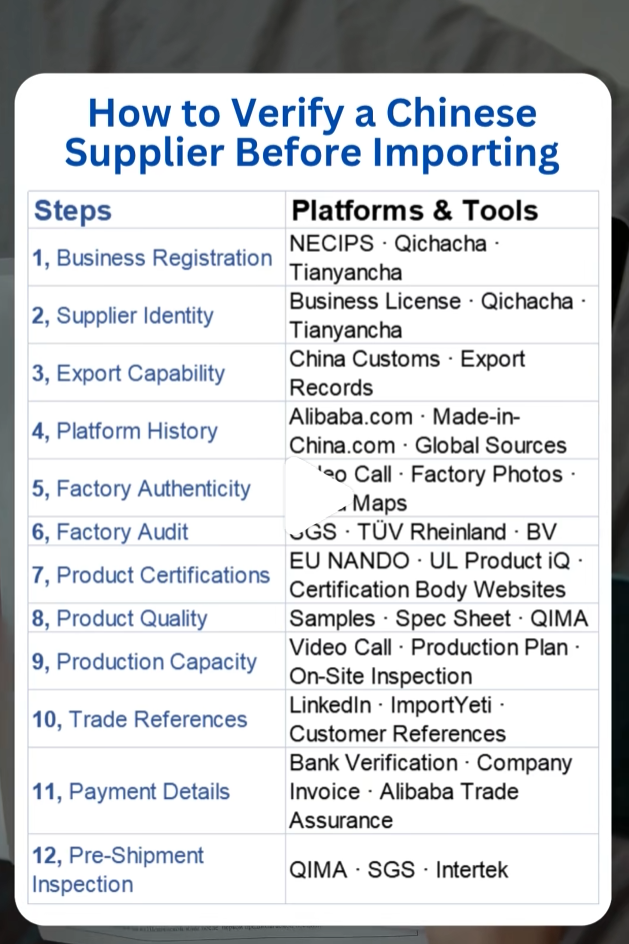
For a broader checklist that applies to any Chinese supplier, see how to verify a Chinese supplier: 12 checks before you pay. The Shandong machinery cases are written up in more detail in the guide to the 9 Shandong machinery suppliers we checked.
What a verification covers
Our China supplier verification service costs US$79 per supplier, or US$60 each for 5 or more, and takes 3 to 5 business days. It covers official registration and court records, a factory or trading company check, a live video walk-through and the decision-maker's contact. That is usually enough to establish whether the Qingdao company is a plant or an export office, and where production really happens. You can see the format in the sample supplier verification report.
When the order value justifies it, an on-site factory audit from US$299 per factory plus travel at cost puts a person in the workshop in Laizhou or Pingdu, checking the licence originals and the production line. Before shipment, a pre-shipment inspection from US$299 per man-day plus travel confirms what is actually in the crates.
One thing to be clear about: I am not a certification body, and I do not issue certificates. I check what the registers say, what the factory shows, and whether the documents match the product you are buying. Buyers pay me; factories never do, and I take no commission from them.
When to ask me to check
Ask for a check when the registered address is an office building and the headcount looks small, when you are buying forklifts or other special equipment and need to see a current TS licence, or when the entity quoting you is not obviously the entity that will build the machine. A short verification before the deposit is far cheaper than discovering after payment that the factory in the contract does not exist, or that the licence expired a year ago.
Get a Quote on WhatsApp See Supplier Verification
LocalAuditChina is an independent verification service, not a certification body. Reports are findings to support your purchasing decision.